Most homeowners don’t start thinking about an accessory dwelling unit because they’re looking for another building to put in the backyard. Usually, something happening in the family gets the conversation started.
Parents are getting older and everyone would feel better having them nearby. An adult child needs a place of their own but isn’t quite ready to buy. Having an au pair or caregiver on the property would make life easier. Or there’s simply enough room on the property to start wondering what else it could do for the family.
Whatever starts the conversation, it’s worth looking beyond the immediate need.
An ADU is a significant investment in your property. If you’re going to build one, it should make sense for the way your family lives today while leaving room for what life might look like years from now.
And it is a significant investment. For a 700 to 900-square-foot ADU, homeowners may be looking at approximately $350,000 to $550,000+ for a basement ADU, $450,000 to $650,000+ for a garage conversion, $650,000+ for an attached addition, and $750,000+ for a new detached ADU.
Those numbers are a starting point, not a fixed price tag. Existing conditions, site work, utilities, structural requirements, and the level of finishes selected for the space can all influence the final investment. A highly customized ADU with detailed millwork, premium cabinetry, tile, lighting, and fixtures will naturally land differently than a more straightforward build.
That makes it even more important to think beyond what the ADU needs to do on day one. When you’re making an investment at this level, the question becomes not only what the space costs to build, but how much use and value it can provide over the decades ahead.
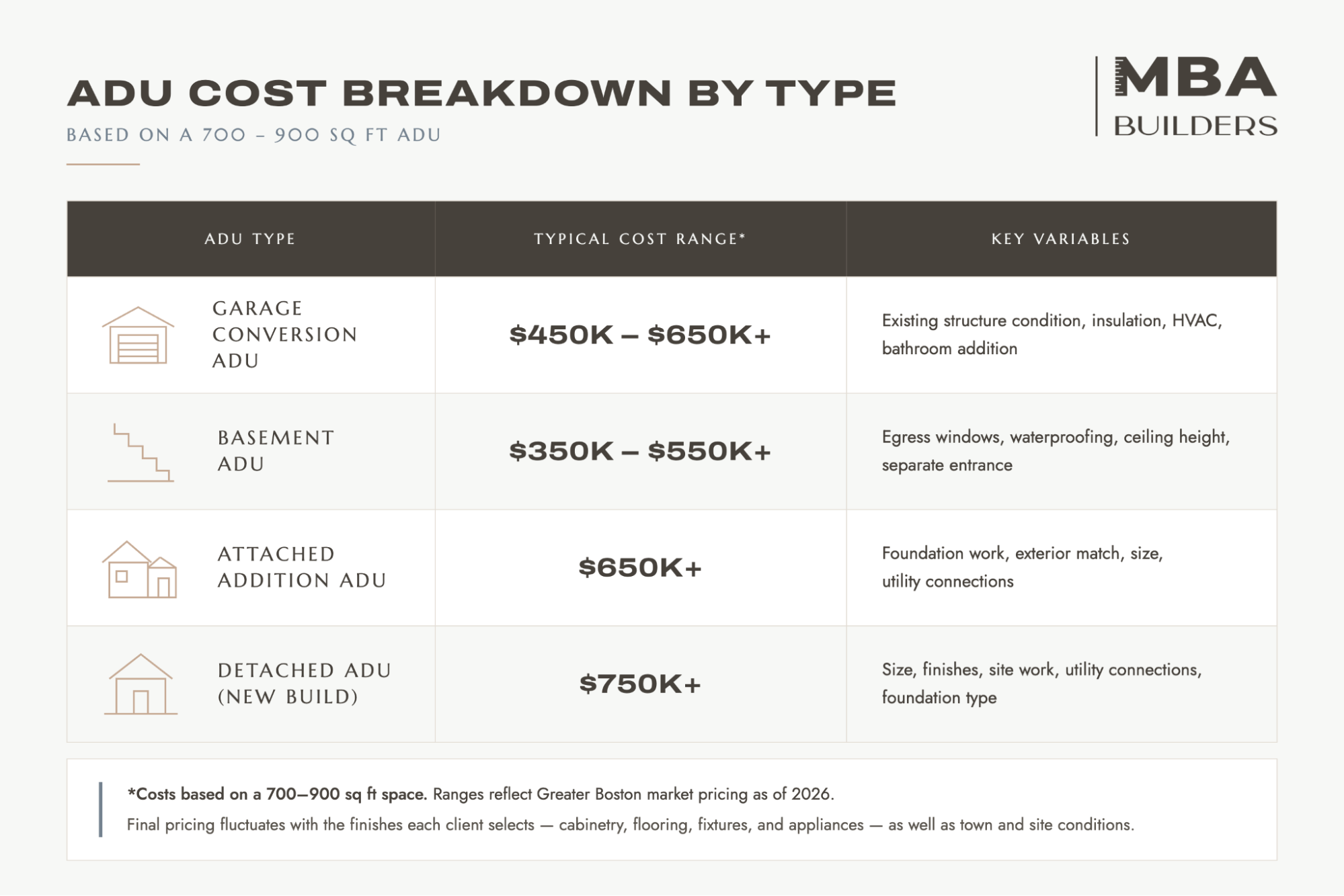
These ranges are intended as a starting point for planning. Final costs vary based on existing conditions, site requirements, utilities, structural work, design decisions, and finish selections.
That’s where the real value of an ADU begins.
Think beyond the first person who will live there
Let’s say you’re considering an ADU for your parents.
Right now, the priorities might be independence and proximity. They want their own home, and you want them close enough that getting together for dinner or helping when they need it doesn’t require a drive across town.
That’s reason enough to build.
But your parents may not be the only people who ever live there.
Years down the road, that same space might become a first home for an adult child, housing for a caregiver, a place for extended family, or a rental. Eventually, it becomes part of the property that you sell or pass along.
You don’t have to know which of those things will happen. In fact, most homeowners couldn’t possibly know.
The goal is to build in a way that doesn’t unnecessarily limit the answer.
An ADU can help parents age in place without giving up independence
There’s a big difference between living alone miles away from family and having your own place a few steps from them.
For aging parents, an ADU can provide privacy and independence while making everyday support much easier. Family is nearby when needed, but Mom and Dad still have a front door to close at the end of the day.
If aging in place is part of the plan, it should influence the design early.
A bedroom and full bathroom on one level, an entrance without unnecessary steps, comfortable circulation through the home, and a bathroom designed with future accessibility in mind may not feel particularly important on move-in day. Years later, they can make an enormous difference.
This is one of the reasons we like to understand not only who will use the space, but how long the family hopes it will work for them.
Building for longevity doesn’t mean trying to predict every possible future need. It means making thoughtful decisions now that may prevent expensive or disruptive changes later.
The investment can continue with the next generation
An ADU built for one generation can eventually become an asset for another.
For an adult child, having a separate home on family property can provide breathing room while they save, establish a career, or figure out their next move. They get greater independence without necessarily taking on the cost of purchasing a home right away.
Look further ahead, and the idea becomes even more interesting.
If the property stays in the family, your children may eventually inherit more than the house you originally owned. They may inherit a property with an additional independent living space that has already been planned, permitted, built, and incorporated into the site.
They can decide what makes sense from there.
They might live in it. A family member might need it. They might be able to rent it. Their own children could someday use it.
That’s one of the ways an ADU can contribute to a family’s generational wealth. The investment being made today can remain useful to the people who own the property next.
Sometimes the value is having help closer to home
There are other stages of life when having another residence on the property simply makes the household work better.
Families with an au pair may appreciate having someone close while maintaining separation between work and personal space. A household caring for a family member may eventually need a live-in caregiver. Other families regularly have relatives who stay for longer stretches of time.
A separate living space changes what’s possible in each of those situations.
And importantly, it doesn’t have to remain an “au pair house” or “caregiver suite” forever.
Good ADU design starts with the current use without making the building so specific that it struggles to serve someone else later.
What about using an ADU as a rental?
Rental income is understandably part of the ADU conversation for some Massachusetts homeowners, and state regulations have recently loosened to make this more possible.
A permitted ADU may create an opportunity for rental income, subject to the regulations that apply to the property and community. That income could become particularly meaningful later in life, or simply provide another way for homeowners to make use of space they have already invested in building.
But we wouldn’t recommend evaluating an ADU solely on a projected rent number.
Particularly when you’re looking at a construction investment that can reach well into the six figures, the math deserves a longer view. Potential rental income may be part of that equation, but so are the years the space could serve your family, the flexibility it adds to the property, and the value of having a permitted, thoughtfully built second living space already in place.
The cost to build, site conditions, utilities, financing, taxes, maintenance, local requirements, privacy, parking, and expected rental demand all deserve consideration.
There’s also the question of whether you’d actually want to rent the space.
That’s why it’s helpful to look at rental potential as one possible chapter in the life of the ADU rather than the only reason the project makes financial sense.
A future buyer may see possibilities you never needed
At some point, the property may leave the family altogether.
When that happens, a well-planned ADU becomes part of what you’re selling.
The future buyer may have completely different reasons for wanting it. Their parents might be moving with them. They may have adult children at home. They could employ an au pair. They may be interested in allowable rental income. Or they might simply value having an independent space available when they need it.
It’s impossible to say that building an ADU will add a specific amount to every home’s resale value. Properties, markets, buyers, construction costs, and ADUs themselves are too different for a blanket number to mean much. Regardless, trends in Massachusetts suggest a well-designed, high-quality, true ADU is a huge value-add.
What you have done, however, is give the property another functional living space and another way to be used.
For the right future buyer, that matters.
Protecting the investment starts with how you build it
An ADU’s long-term value isn’t determined by square footage alone.
If this building may serve your family for decades, how it’s planned and built deserves just as much consideration as what you’ll use it for first.
That includes questions such as:
Planning for the years ahead
- Where does the ADU make the most sense on the property?
- How will the main house and ADU maintain privacy?
- Should the design account for future accessibility?
- How will utilities and mechanical systems be handled?
- Is there enough storage for someone to actually live there comfortably?
- How much maintenance will the selected materials require over time?
- Could the layout work for someone other than its first occupant?
Some of those decisions aren’t particularly exciting. They’re also the decisions that can determine whether an ADU continues to work well 15 years from now.
A beautiful space matters. So does building one that holds up.
Build for this stage of life, and the ones that come after it
We all want the money we put into our homes to matter for the long term.
With an ADU, that return isn’t necessarily measured in one way.
It might mean giving your parents more years of independence. It could mean helping your children get established. It may make caring for someone you love more manageable. Rental income could become useful at another point in your life. And someday, your children or a future buyer may find a completely different reason to value the space.
Most homeowners can’t predict exactly what their family will need 20 years from now. You shouldn’t have to.
But when you’re making this kind of investment in your property, it’s worth leaving room for life to change.
That’s how we think about ADUs. Not simply as extra square footage, but as part of a property that should continue working for the people who call it home.
Let’s Talk About Your ADU Project
If you’re considering an ADU on your Massachusetts property, MBA Builders can help you think through what makes sense now and what may matter later, from site planning and budgeting to design, construction, and the long-term life of the space.
Frequently Asked Questions
Does an ADU add value to a home?
An ADU can add another functional living space to a property, which may make the home more useful and appealing to future buyers. The actual effect on resale value will depend on the property, location, quality of construction, local market, and the ADU itself. We encourage homeowners to think beyond a specific resale number and consider the value of having a space that can serve different purposes over time.
Is building an ADU a good investment?
It can be, particularly when the ADU is designed with more than one stage of life in mind. An ADU might provide housing for aging parents today, serve an adult child later, or potentially become a rental in the future. The financial side matters, but so does creating something your family and property can continue to benefit from for years.
Can I rent out an ADU in Massachusetts?
Massachusetts law has expanded opportunities for homeowners to build and use ADUs, but the requirements that apply to an individual property still need to be understood before making plans around rental income. Local rules and the specifics of your property can affect what is possible. This is something worth confirming early in the planning process rather than after an ADU has already been designed.
Can an ADU be used for aging parents?
Yes. In fact, housing for aging parents is one of the reasons many families begin exploring ADUs. A separate residence can keep parents close to family while preserving their independence and privacy. If aging in place is part of the goal, accessibility and future mobility should be considered during the design process, not added as an afterthought.
Can an ADU be passed down with the property?
An ADU generally becomes part of the entire deeded property, so it can remain with the home when ownership changes, whether the property is sold or passed to the next generation. That long-term usefulness is one reason families may consider an ADU part of a broader investment in their property and generational wealth.
What should I consider before building an ADU in Massachusetts?
Start with the property itself. Available space, setbacks, utilities, access, parking, grading, permitting requirements, and the relationship between the ADU and main house can all influence what’s practical. Possibly a trip to your town’s local building department (ISD or Inspectional Services Department) and a review of your property lines could give some firmer ideas of what is possible within your municipality along with your property. From there, think about who will use the ADU first and how someone else might use it later. Those early conversations can lead to a space that serves the immediate need without limiting what it can become.